
1894 Sasun rebellion
First notable battle in the Armenian resistance movement.

Yerevanci · CC BY-SA 3.0
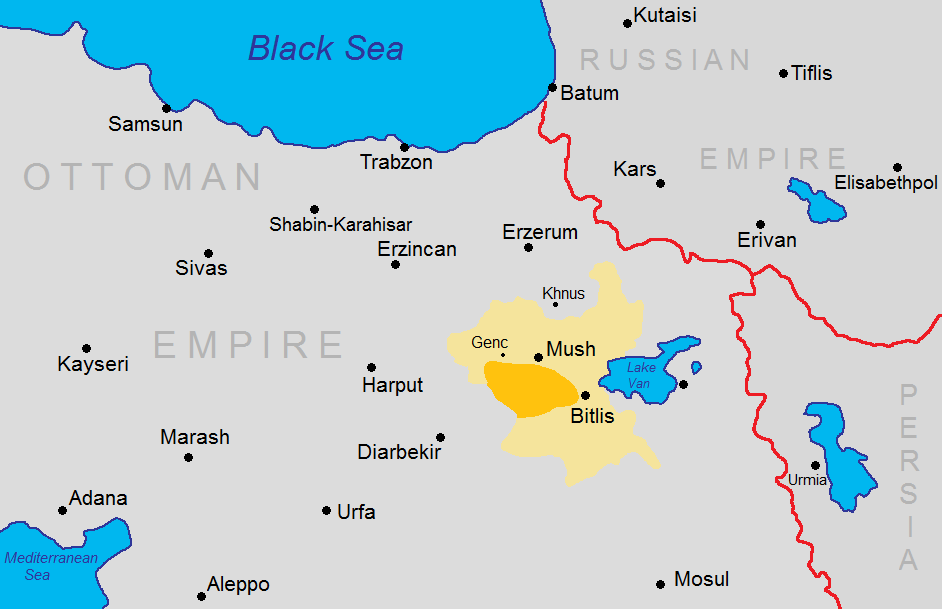
The 1894 Sasun rebellion, also known as the First Sasun resistance, was a conflict between Ottoman Empire's Hamidiye forces and Armenian fedayi of the Hunchakian party in the Sasun region. It marked the first notable battle in the Armenian resistance movement, arising from persecution by Sultan Abdul Hamid II and organized by Hunchak activists such as Mihran Damadian, Hampartsoum Boyadjian, and Hrayr Dzhoghk.
- conflict
- Sasun rebellion (First Sasun resistance)
- year
- 1894
- location
- Sasun region, Ottoman Empire
- parties
- Ottoman Hamidiye forces vs. Armenian fedayi (Hunchakian party)
- key_activists
- Mihran Damadian, Hampartsoum Boyadjian, Hrayr Dzhoghk
- outcome
- Armenians succumbed to superior numbers
Lore & Background
In 1894, Sultan Abdul Hamid II began targeting Armenians, strengthening devolution sentiment. Hunchak activists organized Armenians in Sasun. Missionary Royal M. Cole's unpublished memoir recounted that Tahsin Paşa exaggerated the situation to secure an imperial order for destruction, while Zeki Paşa later criticized him for overstating the threat and causing a massacre on a flimsy pretext.
Reader's Guide
The Sasun rebellion was the first notable battle in the Armenian resistance movement, confronting Ottoman army and Kurdish irregulars. Foreign news agents protested; British prime minister William Gladstone called Hamid 'the Great Criminal' or 'the Red Sultan'. Great Powers demanded reforms and sent an investigation committee. In May 1895, reforms were prepared but never carried out, as Russia's foreign minister supported Ottoman integrity and Britain's priorities shifted. The Ottoman Empire, finding a new ally in Germany's Bismarck, felt free to commit further massacres in 1896.
Did You Know?
- The rebellion is also known as the First Sasun resistance.
- Hunchak activists Mihran Damadian, Hampartsoum Boyadjian, and Hrayr Dzhoghk organized the Armenians.
- Zeki Paşa criticized Tahsin Paşa for causing a massacre on a flimsy pretext.
- British prime minister Gladstone called Sultan Hamid 'the Great Criminal' or 'the Red Sultan'.
Political Roots and the Hunchakian Mobilization
The Social Democrat Hunchakian Party served as the organizational backbone of Armenian resistance in the Sasun region during the early 1890s. Activists including Mihran Damadian, Hampartsoum Boyadjian (known as Medzn Mourad), and Hrayr Dzhoghk worked to build local networks among the mountaineers. Their efforts gained urgency in 1894 when Sultan Abdul Hamid II launched a campaign of targeted persecution against the Armenian population, a precursor to what would later be known as the Hamidian massacres. This wave of state violence intensified devolution and self-determination sentiment among Armenians in the region. The Hunchakian organizers sought to establish self-defense bands among the Sasun mountaineers, a modest but determined effort to protect communities from Ottoman Hamidiye forces. The combination of external threat and internal political mobilization created the conditions for what would become the first major armed confrontation in the broader Armenian national resistance movement.
The Battle and the Fracture Within Ottoman Command
The confrontation at Sasun marked the first significant battle in the Armenian resistance movement. Local Armenian fedayi, organized under the Hunchakian banner, faced off against Ottoman Hamidiye forces and Kurdish irregulars. Despite their resolve, the defenders were ultimately overwhelmed by the sheer numerical superiority of the opposing forces. What makes the military episode particularly revealing is the internal disagreement within the Ottoman command structure. According to unpublished memoirs by missionary Royal M. Cole, based in Bitlis, Tahsin Paşa deliberately inflated the perceived threat in the mountains to justify an imperial order for destruction in late summer 1894. Cole noted that a proper investigation might have revealed only a small number of armed Armenians attempting to form self-defense groups. When Zeki Paşa, commander of the Fourth Army in Erzincan, arrived in early September, he sharply rebuked Tahsin Paşa for exaggerating the danger. Zeki Paşa found the Armenians he observed to be poor and weak-looking, hardly a genuine military threat, and he condemned the massacre as carried out on a flimsy pretext. He also criticized Tahsin Paşa for departing without facing him directly.
International Outrage and the Push for Reform
The violence at Sasun triggered a fierce international response that shook the diplomatic landscape of the era. Foreign news correspondents stationed in the region protested the events with extraordinary vehemence. In Britain, Prime Minister William Ewart Gladstone took the extraordinary step of publicly branding Sultan Abdul Hamid II as "the Great Criminal" and "the Red Sultan," a condemnation that echoed across European capitals. The remaining Great Powers joined in protest, collectively demanding that the Ottoman government carry out the reforms it had previously promised. To investigate the circumstances on the ground, a joint committee composed of representatives from France, Britain, and Russia was dispatched to the Sasun region. This multilateral intervention represented a rare moment of coordinated European pressure on Ottoman internal affairs. The episode demonstrated that the Armenian question had transcended regional politics and become a matter of international concern, with the Sasun events serving as a catalyst for broader diplomatic engagement on the treatment of Armenians within the empire.
The Collapse of Reform and the Road to 1896
Despite the international outcry, the diplomatic momentum generated by Sasun quickly dissipated. In May 1895, the foreign powers did prepare a set of reforms for the Ottoman Empire, but these were never effectively implemented because they lacked the mechanism of active enforcement. Russia, which had been a key voice in the protest, shifted its foreign policy stance. Foreign Minister Alexei Lobanov-Rostovsky championed Ottoman territorial integrity and harbored deeply anti-Armenian views, reportedly advocating for an "Armenia without Armenians." Britain, meanwhile, had consolidated its influence over former Ottoman territories in Egypt and Cyprus, reducing the strategic importance of maintaining good relations with Constantinople. For Gladstone, the Ottoman question had lost its former urgency. Compounding the diplomatic isolation, the Ottoman Empire secured a new European ally in the person of German Chancellor Bismarck. With Great Power pressure effectively neutralized, the Ottoman government felt emboldened to proceed with further massacres in 1896, rendering the Sasun reforms a hollow promise.
Gallery
More in Rebellions in the Ottoman Empire 1-24
Spotted an error? Know more?
This is a living reference — every entry is fact-audited, and reader corrections feed straight into our audit queue. Suggest an edit · See this site's audit record