
Armenian resistance during the Armenian genocide
Armenian resistance combined humanitarian aid and rare armed uprisings.

This is an Archival document which individual author is not published. · Public domain
Armenian resistance during the Armenian genocide encompassed military, political, and humanitarian efforts to counter Ottoman forces and mitigate the genocide during World War I. Early in the war, the Ottoman Empire began efforts to eradicate Armenian culture and eliminate Armenian life through killings and death marches, resulting in the elimination of an estimated 50–75% of the Ottoman Armenian population. Resistance aimed to counter these actions through armed uprisings, humanitarian networks, and military support for Russian forces.
- field
- Resistance movement
- nationality
- Armenian (Ottoman Empire)
- known_for
- Humanitarian networks, armed uprisings, and military support against the Armenian genocide
- key_events
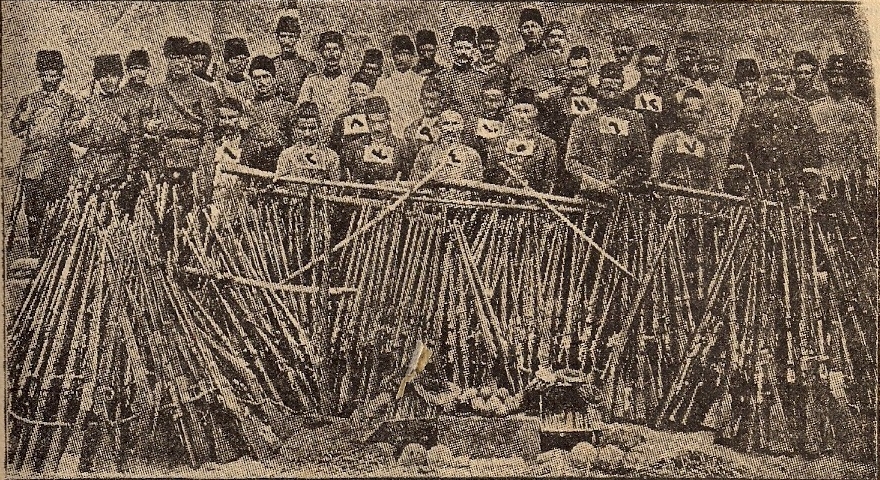
- Defense of Van (1915), Musa Dagh resistance, Urfa resistance
- estimated_lives_saved
- Up to 200,000 (via humanitarian networks)
Lore & Background
Humanitarian resistance involved illegal conduct to mitigate deportation and prevent annihilation. Core actors included religious and civic leaders, doctors, nurses, local Muslims, and foreign missionaries. They established self-help networks supplying deportees with food, fuelwood, and financial support. Initially legal, these efforts faced crackdowns in 1915 and were forced underground, where refugees were hidden in private homes, community centers, and orphanages. Military factories and hospitals under network influence employed Armenians, providing permits to move freely and preventing deportation.
Reader's Guide
Armenian resistance during the genocide is significant for demonstrating both organized humanitarian efforts and sporadic military defiance. Humanitarian networks saved up to 200,000 Armenians by providing basic needs and hiding places, while armed uprisings like the defense of Van and Musa Dagh showed localized success. However, violent resistance was rare and often ineffective compared to humanitarian aid. The resistance also included information gathering through smuggled letters and coded messages, which helped circumvent Ottoman censorship and spurred international support from groups like the ABCFM and the US Armenian relief committee. Military efforts, such as Armenian volunteer units fighting alongside Russia in the Caucasus, contributed to Ottoman defeats but did not halt the genocide. The legacy of this resistance is remembered in cultural symbols like the dish harissa, commemorating the Musa Dagh resistance.
Did You Know?
- Humanitarian networks saved up to 200,000 Armenians from death.
- The defense of Van in 1915 involved around 1,500 armed Armenian fighters, supported by a larger civilian population, and lasted less than a month before Russian forces arrived.
- The village of Urfa resisted Ottoman troops for 25 days from September 29 to October 23, 1915, before being defeated, with most killed or committing suicide.
- The dish harissa is served to commemorate the Musa Dagh resistance.
A Subordinate Existence: Armenians Under Ottoman Rule
Armenians had roots in Anatolia stretching back to the sixth century BCE, roughly fifteen centuries before Seljuk-era Turkmen migrations reshaped the region. By the fourth century CE, the Armenian kingdom had adopted Christianity, establishing the Apostolic Church and a religious identity that endured for millennia. After the Byzantine collapse of 1453, the Ottoman Empire absorbed Western Armenia, governing its Armenian subjects through the millet system—a structure granting non-Muslims property rights and worship freedom in exchange for a special tax, while encoding their subordinate status beneath Islamic law.
By 1914, roughly two million Armenians inhabited Ottoman territory, with 2,084 of their 2,925 settlements clustered in the highlands near the Russian border. Though minorities in most localities, Armenians were overrepresented in commerce. This middleman role, however, conferred little political power. In the eastern provinces they endured semi-feudal exploitation: coerced labor, arbitrary taxation, and unpunished crimes from robbery to sexual assault. Sultan Abdul Hamid II's policy of confiscating Armenian land for redistribution to Muslim immigrants accelerated depopulation, pushing three hundred thousand out of the empire. The Armenian Revolutionary Federation, founded in 1890, emerged from these conditions, seeking internal reform but achieving only limited support.
The CUP's Calculus: From Fear to Annihilation
The Committee of Union and Progress, the ruling party that drove the genocide, viewed the Armenian question through a lens of existential anxiety. The Ottoman Empire's string of military defeats and territorial losses during the 1912–1913 Balkan Wars deepened CUP leaders' dread that Armenians, whose ancestral homeland in Anatolia they regarded as the Turkish nation's final refuge, would seize the moment to demand independence.
When Ottoman forces invaded Russian and Persian territory in 1914, paramilitary units massacred local Armenian populations. The CUP leadership then seized on isolated instances of Armenian resistance—not as localized acts of self-defense but as proof of a coordinated, empire-wide uprising. This interpretation became the ideological justification for a decision of unprecedented scope: to permanently eliminate any possibility of Armenian autonomy or independence. The logic was not merely punitive but preemptive and total. Rather than addressing grievances or negotiating political arrangements, the CUP chose annihilation as its solution, transforming scattered acts of resistance into a mandate for the systematic destruction of an entire people. The decision thus represented a deliberate policy choice, rooted in nationalist fear and the desire to secure a homogenized territorial base for the emerging Turkish state.
The Machinery of Extermination: Deportation and Forced Conversion
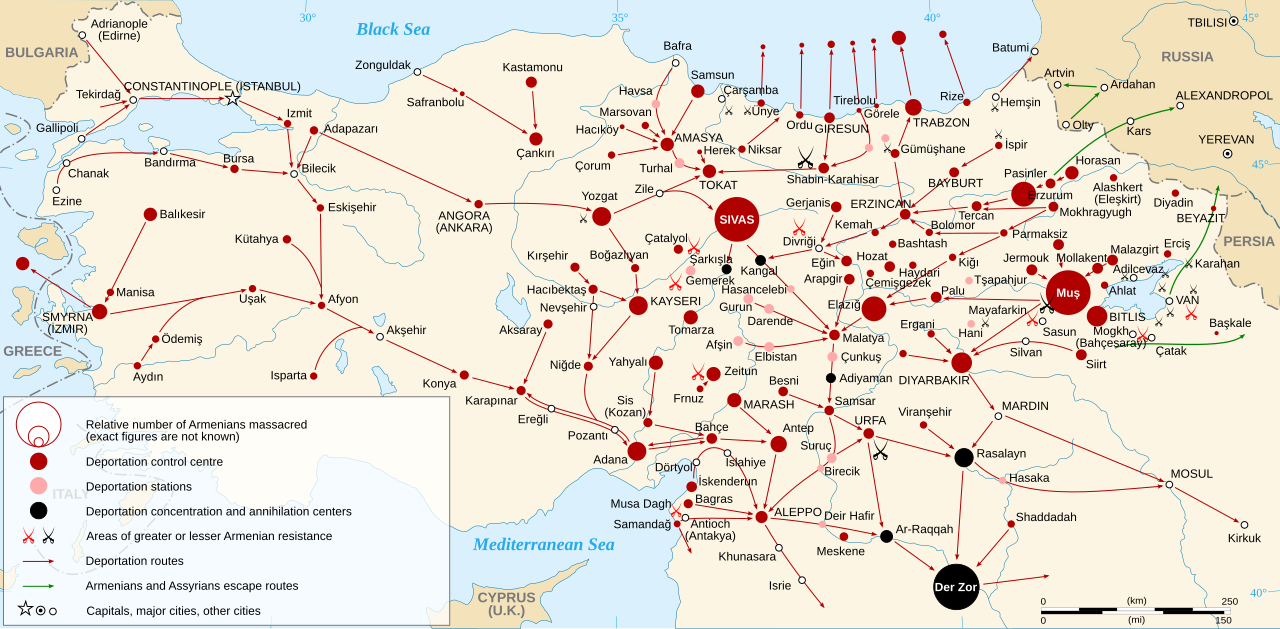
On 24 April 1915, the first wave of state violence swept through Constantinople, where hundreds of Armenian intellectuals and community leaders were seized and deported. This was the opening act of a far larger operation. At the orders of Talaat Pasha, between eight hundred thousand and 1.2 million Armenians were driven onto death marches toward the Syrian desert across 1915 and 1916.
The deportees were herded forward by paramilitary escorts and systematically stripped of sustenance—deprived of food and water while subjected to robbery, rape, and mass killing along the route. Those who survived the marches were scattered into concentration camps. A second wave of massacres in 1916 reduced the surviving deportee population to roughly two hundred thousand by year's end.
Beyond outright killing, the regime pursued a parallel strategy of cultural erasure: an estimated 100,000 to 200,000 Armenian women and children were forcibly converted to Islam and absorbed into Muslim households, severing their connection to language, faith, and community. The combined effect of the death marches, the camp system, and the forced Islamization constituted a coordinated campaign to destroy Armenian identity as a living civilization, not merely to kill its members.
Erasure and Aftermath: Two Millennia Undone
The Armenian genocide stands as what contemporaries called the apex of conceivable horrors before the Second World War. Its impact extended far beyond the immediate loss of life: it obliterated more than two thousand years of continuous Armenian civilization in eastern Anatolia, a cultural presence documented since the sixth century BCE. Together with the parallel genocides of Assyrian/Syriac and Greek Orthodox Christians, the destruction of these communities cleared the demographic ground for the creation of an ethnonationalist Turkish state, the Republic of Turkey.
The aftermath proved equally turbulent. Massacres and ethnic cleansing of surviving Armenians continued well past the armistice, carried out by Turkish nationalists during the War of Independence. The political legacy remains fiercely contested. The Turkish government maintains that the 1915 deportations were a legitimate wartime measure that cannot be characterized as genocide, a position that stands in direct opposition to the broad academic consensus. As of 2026, thirty-six countries have formally recognized the events as genocide, but the dispute over memory, identity, and statehood continues to shape diplomatic relations and collective historical understanding across the region.
Gallery
More in Rebellions in the Ottoman Empire 1-24
Spotted an error? Know more?
This is a living reference — every entry is fact-audited, and reader corrections feed straight into our audit queue. Suggest an edit · See this site's audit record