
31 March incident
An uprising against the CUP in Constantinople, suppressed by the Action Army.

MiNe · CC BY 2.0
In April 1909, during the Ottoman Empire’s Second Constitutional Era, a revolt known as the 31 March incident (Turkish: 31 Mart Vakası) erupted in Constantinople. The name comes from the date in the Rumi calendar: the night of 30–31 Mart 1325, which corresponds to 12–13 April 1909 in the Gregorian calendar. This uprising followed closely on the 1908 Young Turk Revolution, when the Committee of Union and Progress (CUP) had forced Sultan Abdul Hamid II to reinstate the constitution and end his absolute rule. Because of this timing, the event is often called an attempted countercoup or counterrevolution. The revolt was a general uprising against the CUP within the capital, driven mainly by reactionary factions—especially Islamists who resented the CUP’s secularizing policies, and absolutists who wanted the sultan’s old powers restored. Liberal opponents from the Liberty Party also played a smaller part.
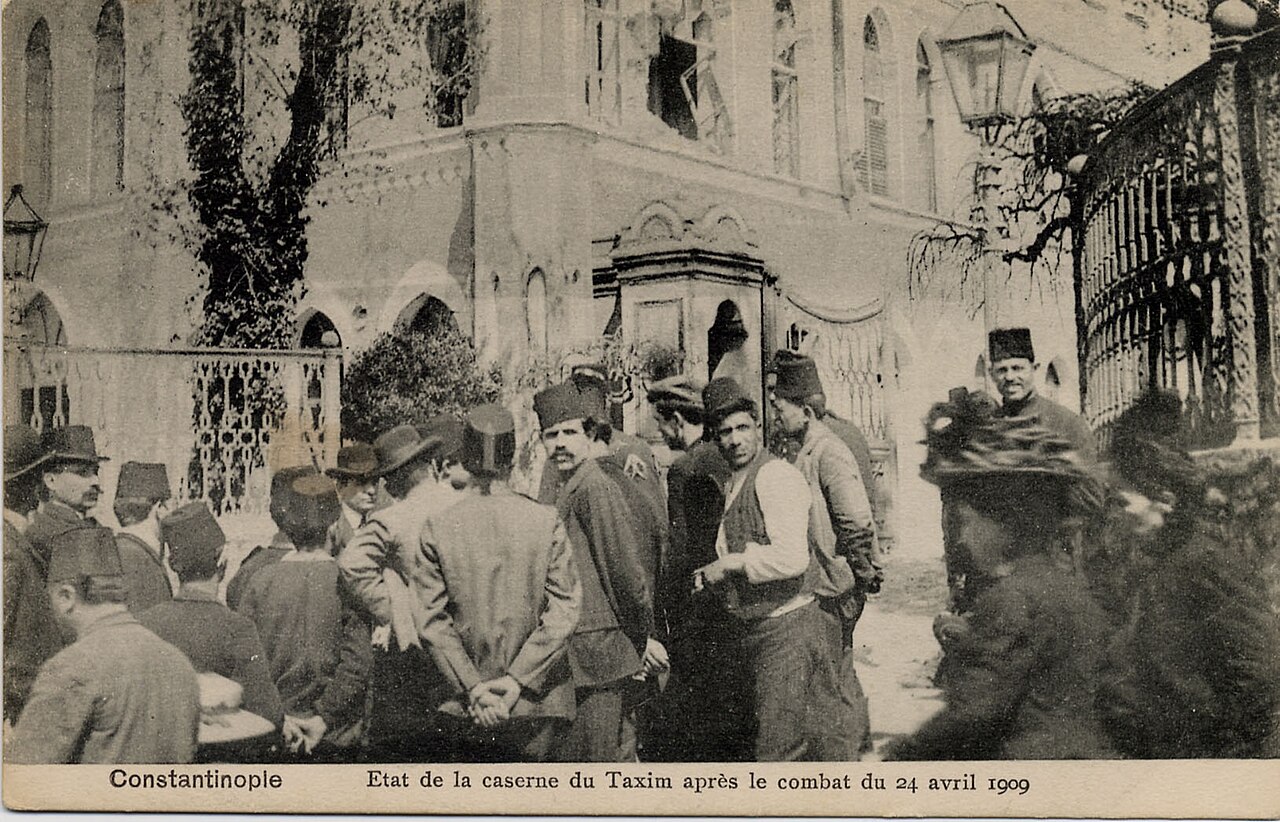
Eleven days later, the uprising was put down and the previous government restored. Troops from the Ottoman Army who backed the CUP formed an improvised force called the Action Army (Hareket Ordusu). When this army entered Constantinople on 24 April, the CUP accused Sultan Abdul Hamid II of being involved in the revolt. He was deposed, and the Ottoman National Assembly placed his half-brother, Mehmed V, on the throne. The general who organized and led the Action Army, Mahmud Shevket Pasha, became the most powerful figure in the restored constitutional system, a position he held until his assassination in 1913.
Historians disagree on exactly what happened. Interpretations range from a spontaneous outburst by disgruntled people to a secretly planned, coordinated counter-revolution against the CUP. Most modern studies dismiss the idea that the sultan actively plotted the uprising. Instead, they emphasize the CUP’s poor handling of troops before the mutiny and the influence of conservative religious groups. The crisis marked an early stage in the empire’s disintegration, setting a pattern of political instability that continued with military coups in 1912 and 1913. The CUP’s temporary loss of power radicalized the organization, making its members more willing to use violence. Some scholars argue that the worsening ethnic relations and breakdown of public institutions between 1908 and 1909 helped set the stage for the Armenian genocide. The crisis also ended the sul
- date
- 12–13 April 1909 (Gregorian calendar)
- location
- Constantinople, Ottoman Empire
- type
- Uprising / attempted countercoup
- key_participants
- Committee of Union and Progress (CUP), Sultan Abdul Hamid II, Action Army (Hareket Ordusu), Mahmud Shevket Pasha
- outcome
- Uprising suppressed; Sultan Abdul Hamid II deposed; Mehmed V enthroned
Lore & Background
The incident broke out during the night of 30–31 Mart 1325 (Rumi calendar), corresponding to 12–13 April 1909. It was a general uprising against the Committee of Union and Progress (CUP) within Constantinople, largely led by reactionary groups, particularly Islamists opposed to the secularising influence of the CUP and supporters of absolutism. Liberal opponents of the CUP within the Liberty Party also played a lesser role. Eleven days later the uprising was suppressed when elements of the Ottoman Army sympathetic to the CUP formed an impromptu military force known as the Action Army (Hareket Ordusu). Upon entering Constantinople on 24 April, Sultan Abdul Hamid II, accused by the CUP of complicity in the uprising, was deposed and the Ottoman National Assembly elevated his half-brother, Mehmed V, to the throne. Mahmud Shevket Pasha, the military general who had organised and led the Action Army, became the most influential figure in the restored constitutional system until his assassination in 1913.
Reader's Guide
The 31 March incident was an important early moment in the empire's process of disintegration, setting a pattern of political instability which continued with military coups in 1912 and 1913. The temporary loss of power led to radicalisation within the CUP, resulting in an increasing willingness among Unionists to utilise violence. Some scholars have argued that the deterioration of ethnic relations and erosion of public institutions during 1908–1909 precipitated the Armenian genocide. The crisis also represented the demise of the Sultanate's power in the Ottoman Empire, as a series of constitutional amendments confined its function in government to the confirmation of parliamentary decisions, conversely cementing parliament's supremacy in a significant step of republicanism in Turkish political history. The precise nature of events is uncertain; differing interpretations have been offered by historians, ranging from a spontaneous revolt of discontents to a secretly planned and coordinated counter-revolution against the CUP. Most modern studies disregard claims the sultan was actively involved in plotting the uprising, emphasising the CUP's mismanagement of troops in the build up to the mutiny and the role of conservative religious groups.
Did You Know?
- The incident is named after 31 March in the Rumi calendar, which corresponds to 12–13 April 1909 in the Gregorian calendar.
- The uprising was suppressed by the Action Army (Hareket Ordusu), an impromptu military force formed by elements of the Ottoman Army sympathetic to the CUP.
- Sultan Abdul Hamid II was deposed after the incident, accused by the CUP of complicity, and replaced by his half-brother Mehmed V.
- Mahmud Shevket Pasha, who led the Action Army, became the most influential figure in the restored constitutional system until his assassination in 1913.
Seeds of Conflict in the Young Turk Revolution's Wake
The 1908 Young Turk Revolution, spearheaded by the Committee of Union and Progress, restored the 1876 constitution and ended Sultan Abdul Hamid II's absolute rule. Yet the CUP, internally fractured and lacking a unified political program, declined to seize direct governmental control. Its Central Committee stayed in Salonika, influencing the parliamentary regime from a distance while cautiously stripping the sultan of military and naval appointments. The interim government under Kâmil Pasha abolished the secret police and lifted press censorship, but throughout 1908 the empire lost significant European territory—Austria annexed Bosnia-Herzegovina, Bulgaria declared independence, and Greece seized Crete. These losses soured popular enthusiasm for the new constitutional order. Open political debate exposed deep cleavages: Muslims viewed the government as weak against European pressure, while minorities, alarmed by promises to reclaim lost lands, feared their hopes for autonomy were dashed. Islamists, who opposed the secular character of the new constitution and equality for non-Muslims, found fertile ground for agitation, and some scholars suggest Abdul Hamid privately sympathized with their cause despite his public embrace of the restored constitution.
The Uprising and the Action Army's March
The revolt erupted during the night of 30–31 March in the Rumi calendar (12–13 April 1909) in Constantinople, taking its name from that date. It was a general uprising against the CUP, driven primarily by reactionary and Islamist factions opposed to the committee's secularizing agenda, with supporters of absolutism and, to a lesser extent, liberal opponents within the Liberty Party also participating. Historians remain divided on the precise nature of the events: some describe it as a spontaneous eruption of discontent, while others characterize it as a secretly coordinated counter-revolution. Most modern scholarship, however, downplays the sultan's direct involvement, instead pointing to the CUP's mismanagement of military deployments and the mobilization of conservative religious groups as key factors. The CUP had transferred three sharpshooter battalions of the Third Army Corps from Salonika to Constantinople in October 1908 to counter concerns about the loyalty of the First Army Corps garrison, yet the mektepli officers who accompanied them became entangled in the capital's political scene. Eleven days after the uprising began, CUP-sympathetic elements of the Ottoman Army formed the Action Army, which entered Constantinople on 24 April and restored the constitutional government.
Deposition, Radicalization, and the Rise of Mahmud Shevket
Upon the Action Army's entry into Constantinople on 24 April, Sultan Abdul Hamid II was accused by the CUP of complicity in the uprising and deposed. The Ottoman National Assembly elevated his half-brother, Mehmed V, to the throne. The military general who had organized and led the Action Army, Mahmud Shevket Pasha, emerged as the most influential figure in the restored constitutional system, a position he held until his assassination in 1913. The crisis also triggered a significant radicalization within the CUP itself. The temporary loss of power during the eleven-day uprising fostered an increasing willingness among Unionists to employ violence as a political tool, a tendency that would shape the committee's governance in the years that followed. Simultaneously, a series of constitutional amendments confined the Sultanate's governmental function to merely confirming parliamentary decisions, cementing the supremacy of the legislature. This represented a significant step toward republicanism in Turkish political history, effectively marking the end of the Sultanate as a meaningful source of executive power in the Ottoman Empire.
A Pattern of Instability and the Road to Tragedy
The 31 March incident is widely regarded as a critical early moment in the Ottoman Empire's process of disintegration. It established a pattern of political instability that persisted through subsequent military interventions in 1912 and 1913, each further eroding the fragile constitutional order. The crisis also had consequences that extended well beyond the immediate political sphere. Some scholars have argued that the deterioration of ethnic relations and the erosion of public institutions during the turbulent period of 1908–1909 created conditions that ultimately precipitated the Armenian genocide. The loss of European territories throughout 1908—Bosnia-Herzegovina to Austria, Bulgarian independence, and the Greek seizure of Crete—had already undermined popular confidence in the new government, while the CUP's promises to reclaim lost lands alarmed minority populations who had hoped for greater autonomy. The tension between Muslim majoritarian sentiment and the rights of non-Muslim communities, exposed by open political debate under the restored constitution, thus set a dangerous trajectory. The 31 March uprising, in this reading, was not merely a political counter-coup but a symptom of the deeper social fractures that would prove fatal to the multi-ethnic Ottoman state.
Gallery

More in Rebellions in the Ottoman Empire 1-24
Spotted an error? Know more?
This is a living reference — every entry is fact-audited, and reader corrections feed straight into our audit queue. Suggest an edit · See this site's audit record