
1904 Sasun uprising
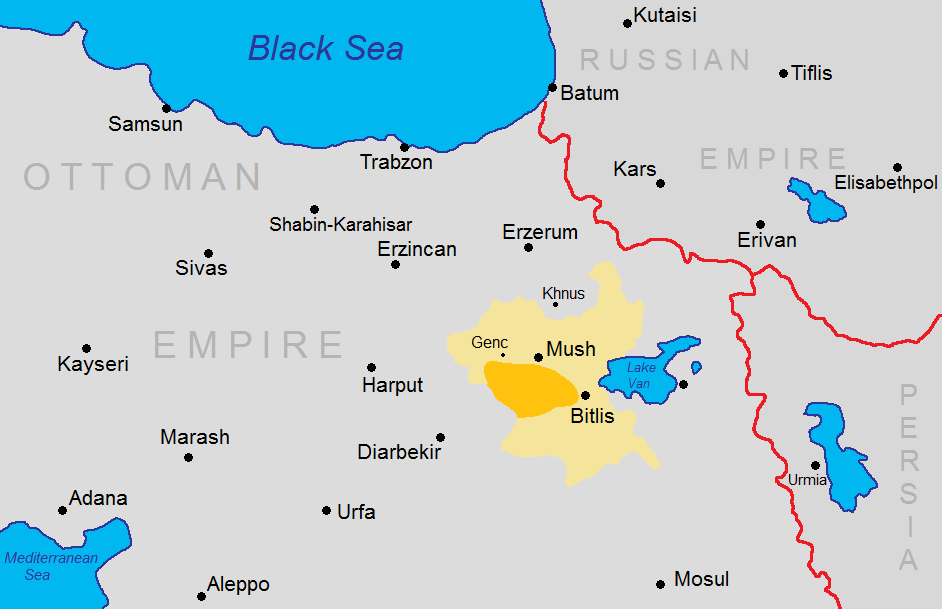
Armenian militia uprising against Ottoman rule in 1904.

Yerevanci · CC BY-SA 3.0
The Sasun uprising of 1904, also known as the Second Sassoun resistance, was an armed rebellion by Armenian militia against the Ottoman Empire in the Sason region. The uprising aimed to prevent the Ottoman Empire from suppressing Armenian autonomy after the First Zeitun Rebellion, and involved Armenian national liberation movements recruiting young Armenians. A European mission later concluded that the Armenians acted in self-defense, not as aggressors.
- casualties
- 1,000–3,000 killed
Lore & Background
The uprising was organized by the Armenian Revolutionary Federation and the Social Democrat Hunchakian Party. In spring 1902, Vahan Manvelyan was sent to Sason to negotiate a ceasefire and concentrate forces for a larger revolt. By 1903, Armenian forces included 200 guerrillas and up to 1,000 armed peasants, facing 10,000 Ottoman soldiers and 6,000–7,000 Kurdish cavalry. The first military action occurred on January 17, 1904, when Kevork Chavush attacked local Kurds to protect Armenian villages.
Reader's Guide
The Sasun uprising of 1904 represents a significant episode in the Armenian national liberation movement, demonstrating both the resolve of Armenian militias and the brutal response of the Ottoman state. The European mission's finding that Armenians acted in self-defense highlights the diplomatic dimensions of the conflict, though Russian ambassadorial delays undermined international intervention. The uprising's failure, marked by heavy casualties and village destruction, foreshadowed later atrocities and reinforced Armenian demands for reform. Its legacy is remembered as a symbol of resistance, though the source notes the Ottoman victory was accompanied by extreme violence, including mutilation and mass killing.
Did You Know?
- The uprising is also called the Second Sassoun resistance.
- A European mission concluded that Armenians were not at fault but acted in self-defense.
- Hrayr Tjokhk was killed at the beginning of the battle on April 13, 1904.
Political Roots and the Road to Uprising
The Armenian national liberation movement had deep roots in the Sason region, with both the Social Democrat Hunchakian Party and the Armenian Revolutionary Federation operating among local communities. The first Sasun resistance had been led by Hunchak-affiliated militia, and tensions between Armenian fedayeen and Ottoman Muslim forces persisted through the early 1900s, with many Armenians forced to convert to Islam or seek protection under the Russian consulate. In spring 1902, ARF representative Vahan Manvelyan arrived in Sason to negotiate a ceasefire and consolidate forces for a larger planned revolt alongside local activist Hrayr Tjokhk. Throughout 1902 and 1903, this consolidation continued, with additional militia groups arriving—though one contingent of 150 fedayeen under Khan and Onik was nearly annihilated by Turkish artillery at the Persian-Turkish border. By February 1903, the ARF in Sofia formally committed troops to the Sason effort, setting the stage for the confrontation that would erupt in 1904.
The Military Stalemate and Key Engagements
The Ottoman response to the growing insurgency was massive: a division of the 4th Corps blocked approaches to Sason with eight battalions later expanded to fourteen, totaling up to 10,000 regular soldiers and policemen alongside 6,000 to 7,000 irregular Kurdish cavalry. Against this, the Armenian side fielded roughly 200 guerrillas under Vahan, Hrayr, and Andranik, supplemented by untrained peasants from 21 villages, bringing the total to around 1,000. Strategic disagreements emerged early: Andranik advocated inciting a general Armenian revolt to stretch Ottoman forces thin, while Hrayr argued that an unsupported uprising would be doomed and urged concentration on defending Sason. The first major engagement came on April 11, 1904, when approximately 7,000 Turkish horsemen entered Shenik only to be trapped between Armenian positions and snow-capped mountains. After four hours of fighting, the Turks abandoned their horses and weapons and fled into the mountains.
Diplomatic Maneuvering and International Pressure
While fighting raged in Sason, a parallel diplomatic effort unfolded among the great powers. The western ARF and the Catholicos sought to pressure Turkey through international channels. The Catholicos appealed directly to the major European powers, and English and French ambassadors in Constantinople secured audiences with the sultan. The sultan agreed to dispatch armies to restore order in Sason, and the ambassadors offered to negotiate on his behalf with the insurgents. However, the Russian ambassador conspicuously delayed his involvement, and by the time diplomatic representatives reached Sason, military action was already at its peak. On April 12, the prior of Surb Arakelots monastery, Arakel, delivered a decree from the Catholicos recommending the Armenians surrender in exchange for amnesty. The Armenian leaders requested a delay before responding, and that night they evacuated and burned several villages in Gelieguzan. Ultimately, a European investigative mission concluded that the Armenians had not instigated the conflict but had acted in self-defense, and it called upon the sultan to enforce the reforms he had previously pledged.
Retreat, Slaughter, and the Human Toll
The final phase of the uprising was marked by devastating losses. After Hrayr was killed at the outset of the battle for Gelieguzan on April 13, fierce hand-to-hand combat ensued, with Andranik striking the Turkish rear from the eastern side. The Turks retreated with reported losses of 136 killed, while the Armenians suffered seven dead and eight wounded. But the broader picture was catastrophic: by April 20, Turkish artillery bombardment forced the fedayeen to retreat to Talvorik, and up to 20,000 civilians—the population of five evacuated villages—fled into the mountains and the Mush plain, where they were slaughtered. Talvorik itself held out until May 6 before falling to Turkish reinforcements, and two hundred fedayeen between Talvorik and Gelieguzan resisted until May 14. The Turkish victory was accompanied by extreme brutality, including the abduction and mutilation of women, a horror that the subsequent European mission documented in its findings.
Gallery
More in Rebellions in the Ottoman Empire 1-24
Spotted an error? Know more?
This is a living reference — every entry is fact-audited, and reader corrections feed straight into our audit queue. Suggest an edit · See this site's audit record